

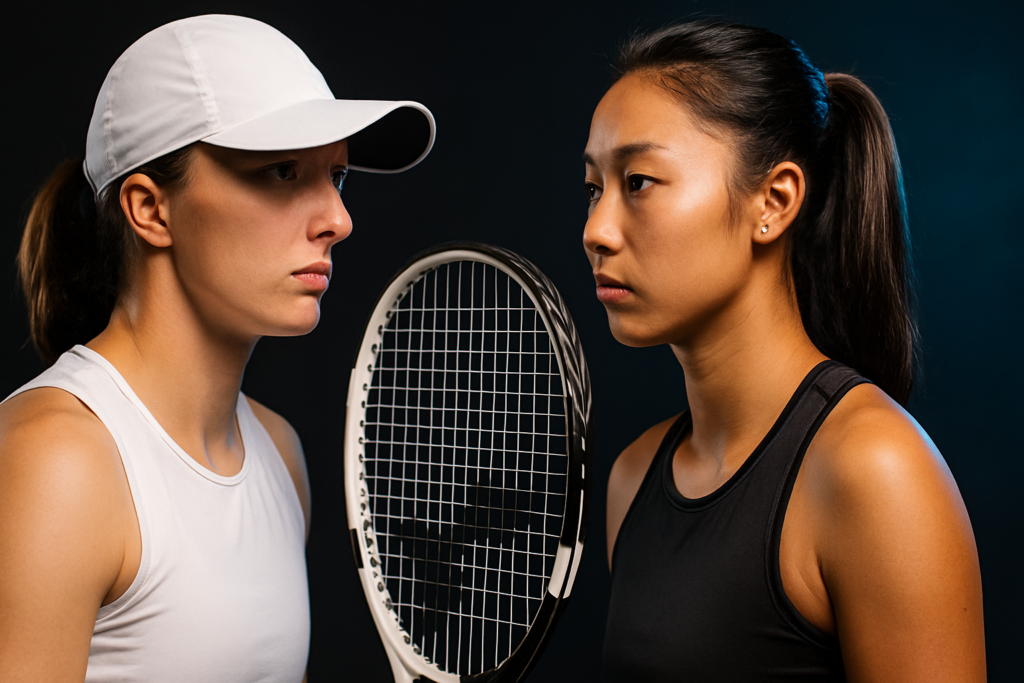
Swiatek vs Zheng prediction: Why Iga is ~80% to win in straight sets at US Open 2026 — and how Zheng could pull off an upset
Estimated reading time: 3 minutes
Key takeaways
- Markets and simulations put Iga Swiatek around a 78–80% chance to win, with straight sets the modal outcome.
- H2H and surface history heavily favor Swiatek: 6–1 overall, 4–0 on hard courts.
- Zheng’s realistic upset path requires a fast, low‑error start, elite serving, and multiple tight sets/tiebreaks.
Short version: most models, markets and previews are giving Iga Swiatek about a 78–80% chance to win this Round of 16 match.
The smart money says she does it in straight sets. That’s not bravado; it’s the neat overlap of head‑to‑head history, surface match‑ups and betting odds that all point the same way.
This is the Swiatek vs Zheng prediction everyone’s whispering about before the match on Monday afternoon in New York.
Swiatek vs Zheng prediction: the market and model picture
You don’t need to squint to see the consensus. Sportsbooks had Swiatek at about -410 (roughly an 80% implied win chance).
Simulation sites are on the same page: Dimers runs the match around 79–80% for Swiatek, Tennis.com’s predictor sits near 78%, and prediction markets price the Pole in the high‑70s as well.
Khel Now collated the book prices; Dimers shared the sim numbers; and Tennis.com lists the match and its own projection.
Put bluntly: the market isn’t split. It’s a wide, steady leaning towards Swiatek — and a lot of analysts expect a two‑set result.
Several tipsters explicitly recommend a Swiatek straight‑sets play, because the models say that’s the modal outcome, not a long shot.
SportyTrader and TheStatsZone are among the outlets tipping Swiatek 2–0.
Swiatek vs Zheng prediction: head‑to‑head and hard‑court history
Numbers you can put a finger on: Swiatek leads the H2H 6–1 and has never lost to Zheng on hard courts (4–0).
Those aren’t marginal edges — they’re the kind of results that shape models and market prices.
The detailed H2H page lists the results and surface split cleanly. TennisTemple is the source for the 6–1 figure and the 4–0 hard‑court stat.
Look at the pattern: Zheng has occasionally taken or troubled Swiatek early in matches — she took the first set at Roland‑Garros 2022 — but Swiatek’s response almost always ends up decisive.
Several hard‑court meetings were one‑sided (6–0, 6–2; 6–1, 6–1; 6–2, 7–5, etc.), which is why the markets price Swiatek not only to win but to do it comfortably.
Why the match shape favors Swiatek (tactical snapshot)
There’s a simple stylistic reason behind the numbers. Swiatek brings elite return skills, heavy, depthy topspin that the DecoTurf at Flushing Meadows tends to reward, and a habit of adjusting mid‑match to neutralize opponents’ hot spells.
Previews repeatedly point to this return advantage and the surface fit as decisive factors.
If Zheng’s serve isn’t firing at a top‑level clip, Swiatek can extend rallies, pressure second serves and tilt short points into longer ones where her consistency pays off.
Sportskeeda summarizes this neatly: return + surface + Swiatek’s ability to solve Zheng’s surge.
Zheng’s plus: she’s an aggressive player with a flat, punchy forehand and the kind of serve that can yield free points if it’s clicking.
She’s been to the US Open quarters twice, so she’s not intimidated by the stage. But in past meetings she often can’t sustain that intensity long enough to avoid being dragged into Swiatek’s comfortable rhythm.
How Zheng actually pulls off an upset — the precise pathway
If you like rooting for the underdog (or hunting value), here’s the narrow doorway that leads to a Zheng win. It’s short, and you need most of the pieces to line up.
- Fast, flawless start: Zheng must take the first set. In previous H2H meetings she’s opened strong on occasion; Roland‑Garros 2022 saw her nick the first set before Swiatek flipped the match. Early lead forces Swiatek to play catch‑up — that incubates pressure and tighter Swiatek patterns for a spell. (See the H2H timeline at TennisTemple.)
- Serve efficiency: Zheng needs a first‑serve percentage in the high‑60s (relative to her norms) and a spike in aces or unreturnables. When Zheng’s serve is firing she shortens points and limits Swiatek’s return leverage.
- Low‑error aggression: Being flat and aggressive only helps if it doesn’t produce a deluge of unforced errors. Zheng’s upset path requires crisp, selective aggression — winners instead of wild misses.
- Tight sets and tiebreaks: If Zheng can manufacture tiebreaks or one‑point margins repeatedly, variance rises and the market’s certainty falls. Prediction markets show that under 2.5 sets is a heavy favorite; flip those close sets and you have a realistic route to three sets or even a Zheng comeback. (Khel Now’s contrarian pick of Zheng in three is an example of this line of thought.)
- Exploit any Swiatek dip: There was an “unexpected scare” for Swiatek in Round 3, described by match commentary as a lapse rather than an injury. If a mental or tactical wobble recurs, Zheng must punish it rapidly and keep the scoreboard honest. Match notes flagged that scare earlier in the tournament.
Get four of those five right and you’ve got a plausible upset. Miss one or two and the probability deck stacks back toward Swiatek — which is exactly why the moneyline sits where it does.
Markets, props and the “value” plays
If you’re mapping this like a bettor or just trying to understand the consensus, these are the clean angles that float across tip sites and models.
- Primary bookend: Swiatek moneyline (circa -410) — the consensus play but low edge. Khel Now shows the book grid that got this price.
- Swiatek straight sets prediction: Many analysts and tipsters back a 2–0 result — SportyTrader and TheStatsZone explicitly list Swiatek 2–0 as their pick. SportyTrader is among them.
- Handicap angle: Swiatek -4.5 is modelled as marginally likely — Dimers puts the chance to cover at about 53% — so it’s a reasonable middle ground if you expect a comfortable Swiatek win but not a blowout. Dimers ran those numbers.
- Totals: Books and sims are clustered around 20–21 total games — the expectation is a competitive straight‑sets match (e.g., 6–4, 7–5 or 7–5, 6–3) rather than a 6–1, 6–0 rout.
- Longshot contrarian: Zheng moneyline (+361 in some books) or Zheng to win 2–1 (Khel Now highlighted Zheng in three as an outsider pick). Those plays are narrative‑driven but not without historical precedent: Zheng has beaten top opposition when her serve and forehand are on. Khel Now shows that contrarian stance.
One responsible note on betting language: the markets are clear but not infallible. If you’re placing anything beyond a small, recreational wager, keep stakes proportionate to the real probability gaps the models show.
What to watch during the match — live triggers that shift probability
Three‑minute scouting: which in‑match events materially change the forecast?
- First set winner: the models put big weight here — Swiatek’s chance to take set one is roughly 74–75%. Lose that and Zheng’s live odds improve a lot.
- First‑serve % and free points: if Zheng’s first‑serve percentage slips below her norm and she gives Swiatek lots of second serves, Swiatek’s return advantage will turn games fast.
- Break‑point conversion: Swiatek tends to press returns into break opportunities; if Zheng saves a high share early, momentum can flip toward a nervous Swiatek.
- Tiebreaks: Zheng’s upset path disproportionately depends on sending sets to tiebreaks. Tight tiebreak records and a couple of lucky calls can swing a match-friendly narrative.
- Swiatek’s in‑match adjustments: historical H2H shows that if Swiatek loses the opener she often adapts and runs away with the later sets. If you see that mid‑match retooling (more depth, heavier kick on the backhand), the match is likely tilting back to her favour.
Frequently Asked Questions
Swiatek vs Zheng prediction — what’s the single most likely scoreline?
The consensus answer is a Swiatek straight‑sets win, and the market expects a competitive two‑set match (examples like 6–4, 7–5 are plausible).
Multiple tipsters and models favor Swiatek 2–0. SportyTrader and others list a straight‑sets pick.
How much does the 6–1 H2H matter?
It matters a lot. A 6–1 H2H and a 4–0 record on hard courts tell you this isn’t a matchup where Zheng is a stylistic nightmare for Swiatek — the Pole has repeatedly solved her game.
See the match log at TennisTemple.
Is Swiatek a safe bet to win in straight sets?
“Safe” is never a word you want in sports, but probabilistically yes: the models put straight sets as the most likely outcome.
Polymarket and simulation models skew heavily toward under 2.5 sets, and multiple preview sites recommend Swiatek 2–0.
What are the realistic Zheng bets?
Higher‑risk, higher‑reward plays are Zheng moneyline or Zheng to win 2–1. Those are narrative bets — they lean on a fast start, a high first‑serve success rate, and forcing tight sets.
Khel Now even highlights a Zheng‑in‑three as a contrarian pick.
Are there any fitness or injury concerns?
No notable injury reports for either player were cited in the previews.
RotoWire noted Swiatek’s comfortable third‑round win and match reports described the earlier “scare” as a tactical wobble, not a physical issue. Both are listed as match‑fit in previews and H2H pages.
Where can I see the odds and projections?
For quick reference: Khel Now aggregates the book prices; Dimers has simulation probabilities; Tennis.com shows the match predictor.
Conclusion — the one thing to remember
Swiatek vs Zheng prediction: the clean takeaway is that Iga is the heavy favorite — roughly 78–80% to win — and the likeliest route is straight sets, backed by a 6–1 H2H and 4–0 hard‑court record.
Zheng isn’t without a path — a blistering start, elite serving and tight tiebreaks can flip things — but all the models and markets agree this is an uphill road.
If you want a single sentence to carry into the match: Swiatek is expected to control the scoreboard; Zheng’s upset requires near‑perfect timing and execution from the first ball.